Disclosure: this site is run by a Buildy affiliate. If you sign up to Buildy through the links in this article, we may earn a commission, at no extra cost to you.
Open your homepage and read it the way a stranger would. "Fast." "Trusted." "Results you can see." "Loved by customers." Each of those is a promise, and each one quietly asks the visitor to take your word for it.
Those words are easy to scroll past because visitors have seen them so often. Put a real receipt beside a claim, and you give people a reason to believe it.
Here is the uncomfortable part for a solo founder: the receipts exist more often than you think. They are sitting in your inbox, your DMs, your order notes and your own memory, scattered and never collected. The marketing job nobody does is gathering them. This article is about handing the sorting, drafting and organizing of that job to AI, while the truth stays with you.
The problem: claims are cheap, proof is work
Writing "customers love it" takes four seconds. Proving it takes a message to a customer, a reply, a permission, a bit of editing and a place to put it. So founders keep writing the four-second version, and the site fills up with adjectives.
Three things make proof hard to collect when you work alone:
- You do not know which claims need it. After months of writing your own copy, every sentence looks reasonable.
- Asking feels awkward. Messaging a customer for a quote feels like a favor, so it gets postponed.
- Raw feedback is messy. A rambling voice note or a two-line email is not something you can paste onto a page.
All three are tasks AI handles well: reading a lot of text and spotting claims, drafting a polite and specific request, and tidying messy material into a draft that you then approve. What AI cannot do is create the evidence. That line matters, and we will come back to it.
The Proof Ledger
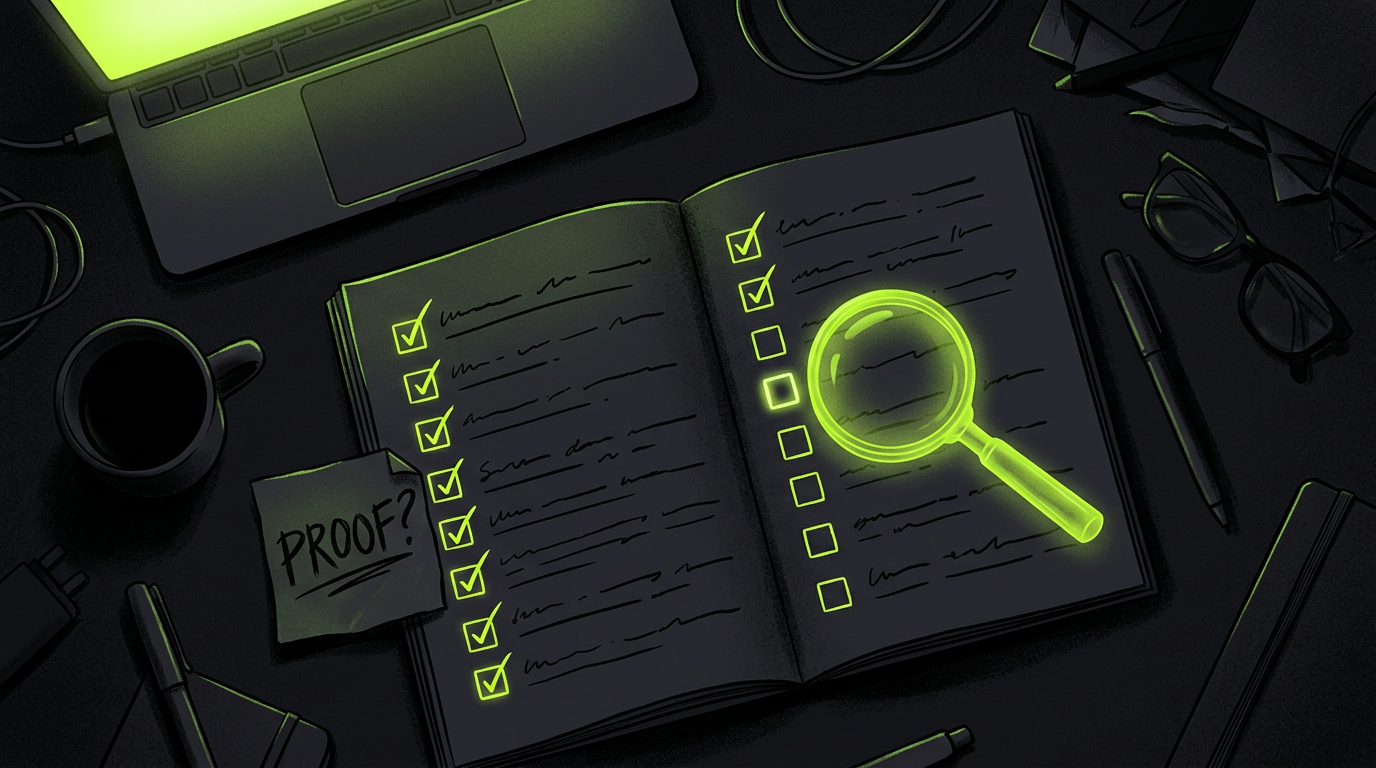
The Proof Ledger is a simple table you keep in a document or spreadsheet. One row per claim you make in public. Five columns:
| Column | What goes in it |
|---|---|
| 1. The claim | The exact sentence, copied from your site, ad or post. |
| 2. Where it lives | The page or channel, so you can fix it later. |
| 3. The receipt | What backs it up: a customer message, a screenshot, a number from your own records, a demo, a policy. Blank if there is none. |
| 4. Status | Proven (real evidence directly supports the claim), Provable (evidence may exist but still needs collecting and checking) or Unprovable (you cannot back it up). |
| 5. Next move | Keep, collect, soften to what is true, or cut. |
That is the whole tool. Its value is that it turns the vague worry "my site needs more trust" into a short, specific list of jobs. Here is how to build it in about an hour.
Step 1: Pull every claim out of your marketing (15 minutes)
Copy the text of your homepage, your main offer page, your most recent ad and your bio into one document. Then give AI a narrow job:
Below is the public marketing text for my business. List every sentence that makes a claim a skeptical customer might question: results, speed, quality, popularity, comparisons, guarantees, or words like "best", "trusted" and "proven". Quote each sentence exactly. Do not rewrite anything and do not add claims of your own.
You will usually get a longer list than you expected. That is the point. Founders are often surprised by how many promises they made without noticing.
Step 2: Match each claim to what you really have (15 minutes)
Now do the part only you can do. Go down the list and fill in column 3 from your own records. Be strict with yourself:
- "Customers love it" is backed by actual messages from actual customers, not by a feeling.
- "Fast delivery" is backed by what your orders show, not by what you hope is true.
- "Used by founders" needs you to know who, and to be able to say so.
If you want help, paste in real material, such as a folder of customer emails or a list of review excerpts, and ask AI to find passages that relate to each claim. Tell it to quote the passage and name where it came from, and to say "no match found" when there is none. Then check the quotes against the originals yourself. A good rule: AI points, you verify.
Step 3: Sort into Proven, Provable and Unprovable (5 minutes)
Mark each row honestly using these three categories:
- Proven rows need nothing. Maybe you move the receipt closer to the claim, so the visitor sees both together.
- Provable rows are your opportunity. You have a lead on evidence, but need to collect and check it before treating the claim as proven.
- Unprovable rows are a decision. Either find a version you can stand behind, or cut it. "The best in the industry" becomes a specific thing you actually do, such as "every order checked by hand before it ships", but only if that is true.
This step has a quiet side effect: your copy gets more believable even before you collect anything new, because the empty claims are gone.
Step 4: Draft the proof requests (15 minutes)
For each Provable row, you need something from a customer or from your own records. This is where most founders stall, and where AI helps most. The trick is to ask a question that makes a useful answer easy, rather than begging for "a testimonial".
Try this prompt:
I want to ask a customer for feedback that could support this claim on my site: [claim]. Write a short, friendly message, under 90 words, with two specific questions that are easy to answer in a sentence or two. Questions should be about what they were trying to do and what changed. Do not suggest answers or put words in their mouth. Add one line asking whether I may quote their reply publicly, and by what name.
Notice what that prompt avoids. It does not hand the customer a script, and it does not ask for praise. It asks what they wanted and what changed, which is where honest, specific proof lives. For illustration, a detailed answer might say: "I needed my invoices out before month end and it took one evening." The useful detail is what the customer needed and what happened.
The permission line is not optional. Quote only what people agree to have quoted, under the name they agree to.
Step 5: Turn raw replies into usable proof (10 minutes)
When replies arrive, they will be short, messy or oddly formatted. Ask AI to help you tidy without changing the meaning:
Here is a customer's reply. Pull out the one or two sentences that best show what changed for them. Keep their exact words. Only trim for length and fix obvious typos. Show me the original beside the trimmed version so I can check that the meaning is the same.
Then send the trimmed version back to the customer and ask, "Is this okay to publish?" A one-line confirmation protects them and you.
If you want to go further, AI can outline a short case study from a longer exchange: the situation, what they tried, what they did with your product, what changed. You supply the facts and the approval. AI supplies the structure.
Where AI must stop
This routine only works if one rule never bends: AI organizes evidence; it never manufactures it.
An AI tool will happily write a convincing review, a neat percentage or a confident "trusted by thousands". Every one of those would be fake, and fake proof is worse than none. It can break your customers' trust, and in many places it can break advertising rules. Guardrails worth writing at the top of your document:
- No quote, number, name or result goes on a page unless you can point to where it came from.
- No statistics unless they come from your own records or a source you can cite.
- One customer's result is described as that customer's result, never as what everyone gets.
- Sample or illustrative material, if you ever use it, is labeled as such where it appears.
If your ledger shows you have little real proof yet, that is not a failure. It is a map. Early on, you can still earn belief by showing your work: a clear demo, a plain explanation of how the product works, honest terms, a small low-risk first step. Proof can start with transparency and grow with customers.
Make it a habit, not a project
The ledger pays off when it stays alive. A light routine:
- Every new claim gets a row before it goes live. If you cannot fill column 3, you are not ready to say it.
- Every happy customer message gets filed. When someone writes something kind, copy it into a "possible proof" folder right away, and ask for permission while the moment is fresh.
- Once a month, rerun Step 1 on your updated pages and see what new claims crept in.
Ten minutes a month keeps your marketing honest and your evidence ready.
Where Buildy fits
The Proof Ledger is a perfect example of work that a solo founder skips because it is small, scattered and never urgent. That is the same kind of work Buildy is built to take off your plate. Buildy is an AI-powered business team of seven specialized agents covering strategy, design, development and marketing, so the page that holds your proof, the campaigns that point to it and the content around it can come from one workflow instead of a stack of separate tools.
Your claims, your customer facts and your approval still come from you. The drafting, structure and consistency do not have to.
If you are a non-technical founder who wants to see how that works, you can try Buildy here. As disclosed above, that link is an affiliate link.
Your 60-minute plan
- Copy your homepage, offer page, latest ad and bio into one document.
- Ask AI to quote every sentence that makes a claim. Do not let it rewrite anything.
- Build the ledger: claim, location, receipt, status, next move.
- Mark each row Proven, Provable or Unprovable, and soften or cut the Unprovable ones.
- Draft one short, specific proof request for each Provable claim, and send the first two today.
- When replies arrive, trim with AI, confirm with the customer, then publish only what they approved.
Your visitors are already asking, "Why should I believe you?" Answer it with evidence that is yours, collected one honest receipt at a time. When you want a team that helps you build the page, the campaigns and the follow-through around that proof, see what Buildy can do for you.
