Disclosure: this site is run by a Buildy affiliate. If you sign up to Buildy through the links in this article, we may earn a commission, at no extra cost to you.
Think about where your marketing time goes: the landing page, the ads, the posts, the launch email. So much of the work points at one moment: when a stranger becomes a customer.
Then the yes arrives, and the marketing stops. The buyer gets an automatic receipt, maybe a thank-you page, and after that, silence. Not because the founder doesn't care. Because they are exhausted, the next sale needs chasing, and nobody is on the payroll to write the follow-up.
That silence is the quiet half of marketing. It is where a new customer decides whether they made a good choice, whether they will use what they bought, whether they will tell anyone, and whether they will ever buy again. It is also the half that AI handles unusually well, for a plain reason: it is repetitive, it follows a pattern, and it needs your real facts more than your creativity.
Why the second half gets skipped
Post-sale marketing loses to pre-sale marketing for three reasons:
- It feels optional. A missing launch post costs you visibility today. A missing check-in costs you something you will never see on a dashboard.
- It is many small jobs. A welcome note, a how-to-start message, a review request, a referral ask. Each is easy to put off, even though the work adds up.
- It needs knowing the customer's next step. That takes thought about what happens after purchase, and most founders have never written it down.
Small, repetitive, unglamorous and easy to postpone: that is the exact profile of work to hand to AI. The thinking about what your customer needs stays with you. The drafting, variations and consistency do not have to.
The Day-After Map
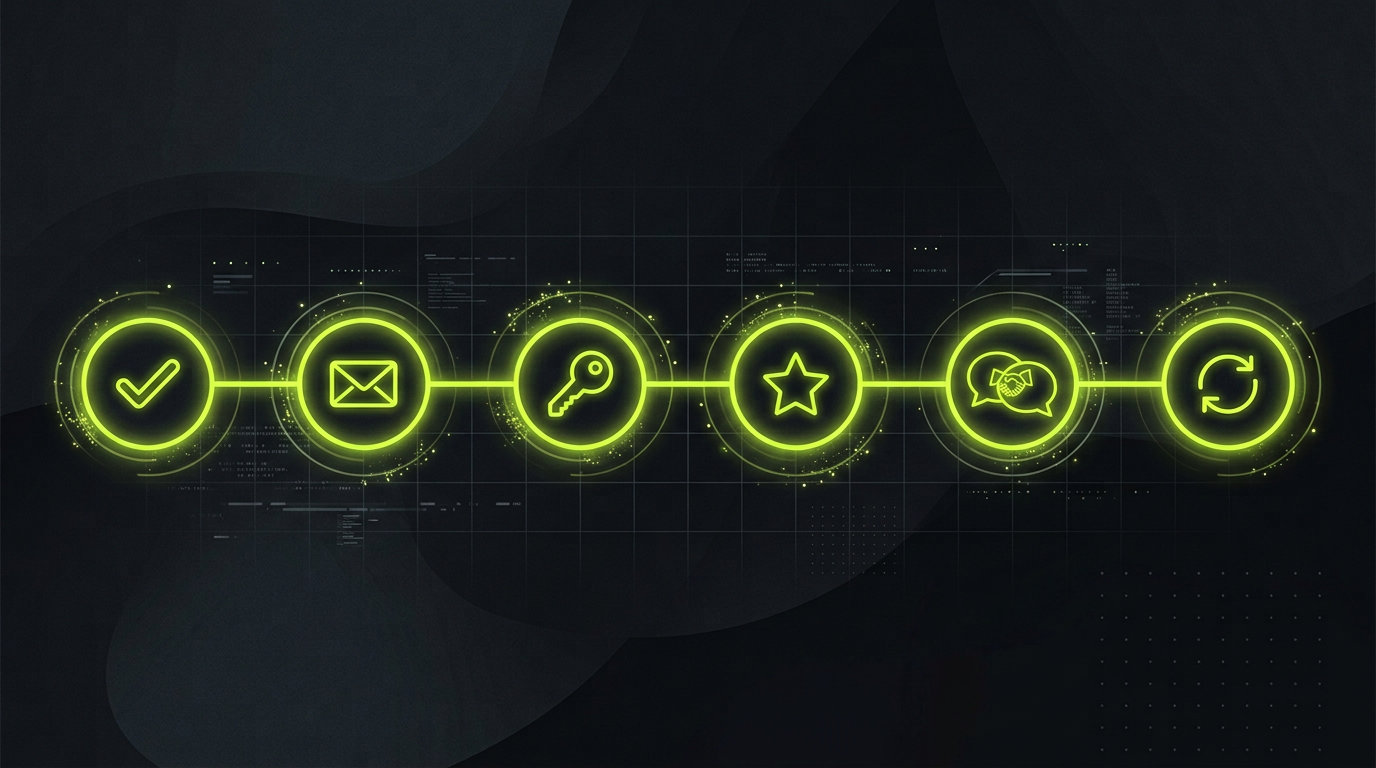
Here is a simple tool. Instead of a vague "customer journey," list the six moments after a yes where a short, well-timed message can matter. Think of it as a map of the days after the sale.
| Moment | What the customer is thinking | The job of your message |
|---|---|---|
| 1. The confirmation | "Did that work? What now?" | Confirm, set expectations, say what happens next and when. |
| 2. The first step | "How do I start?" | Make the first use easy. One action, not ten. |
| 3. The first result | "Is this actually helping?" | Help them notice the first win, or fix the first snag. |
| 4. The review ask | "Was it worth it?" | Invite honest feedback while the experience is fresh. |
| 5. The referral ask | "Who else needs this?" | Make it easy and natural to pass it on. |
| 6. The quiet stretch | "I forgot about this." | Reconnect with something useful, not a guilt trip. |
You do not need all six on day one. Even writing the first two is a real change for most small businesses. But the map is useful because it turns "I should follow up with customers" into six specific messages with six specific jobs.
Step 1: Write the facts only you can write
AI cannot know what happens after someone buys from you. If you let it guess, it will invent a generic process that may not match your business at all, which is worse than sending nothing.
So start with a short fact sheet, written in plain sentences. Spend 20 minutes on it:
- What exactly does the customer get, and when?
- What is the single first action they should take?
- What are the two or three questions customers ask most in the first week?
- What is the most common thing that goes wrong, and how do you fix it?
- Where do you want a review to go, and where do you want referrals to land?
- How do you like to sound? Paste in two or three things you have written that felt like you.
This fact sheet is the most valuable asset in the whole routine. Everything AI drafts is only as true as what you put in here.
Step 2: Draft the six messages with one prompt each
Paste your fact sheet into your AI tool, then work through the map one moment at a time. Here is a prompt for moment 1, which you can adapt for the rest:
You are writing a short confirmation message for a customer who just bought from my small business. Use only the facts below. Do not invent delivery times, features, policies or guarantees. Tell the customer what they bought, what happens next and what to do if they have a question. Keep it under 120 words, warm and direct, in the style of the writing samples I pasted.
For moment 3, the first result, try this instead:
Write a short check-in for a customer who bought three days ago. Ask one question: have they been able to complete the first step? Offer the two most common fixes from my fact sheet. Do not promise any outcome. Keep it under 100 words.
Notice the pattern in both prompts: a source of truth, a banned list ("do not invent"), one job and a length limit. That structure gives AI the context it needs to draft a useful message. Check the result against your fact sheet before sending it.
The two messages that need extra care
Moments 4 and 5, the review and referral asks, are where AI can help you embarrass yourself if you are careless. Keep these rules:
- Ask everyone, not only the happy ones. Sending the review link only to people you think are satisfied distorts what the public sees, and some review platforms prohibit it. Send the same invitation to all customers.
- Never write the review for them. AI can draft your request. It must never draft the review, and you should never post reviews that real customers did not write.
- Do not dangle rewards for positive reviews. Ask for honest feedback. Platform rules on incentives vary, so check the rules of wherever you collect reviews.
- Make the referral ask specific. "Know anyone else who needs this?" works better when you name who it is for: "If you know another freelancer who dreads invoicing, here is a link they can use." Only mention a referral reward if you actually offer one, and describe it exactly as it works.
Also confirm that you have the right to message the people on your list. The rules about email and text consent differ by country, and the fact that someone bought from you does not always mean they agreed to marketing. When unsure, check your local rules and include a clear way to opt out.
Step 3: Read what comes back like a skeptical customer
Before any draft goes live, run a quick check:
- Is every fact true? Delivery times, links, prices, names. Check each against your fact sheet.
- Would you send this to a friend who just bought from you? If it reads like a corporate form letter, rewrite the opening line in your own voice.
- Does it ask for one thing? A message that asks the customer to start, review, refer and follow you has asked for nothing.
- Does it sound pleased with itself? Cut the lines that tell the customer how lucky they are.
An illustration of the map in use
Here is a made-up example, so you can see how the pieces fit. It is a fictional business and not real results.
Illustrative scenario: you run a one-person service that creates monthly bookkeeping summaries for freelancers.
- Moment 1: "Thanks for signing up. Here is what I need from you this week: your bank export and your invoice list. Your first summary arrives on the 5th."
- Moment 2: "The only thing to do today is upload your bank export. Here is a two-minute guide with screenshots."
- Moment 3: "Did the upload go through? The two usual snags are the file format and the date range. Here is the fix for each."
- Moment 4: "Your first summary is in. If you have a minute, I would value an honest note on what was useful and what was not."
- Moment 5: "If you know another freelancer who dreads this, here is a link they can use to look around."
- Moment 6: "Tax season tends to sneak up. Here is a short checklist of what to gather this month."
Every message above does one job, uses a fact only the founder could supply and is short enough to be read on a phone in the queue for coffee. AI could draft all six in minutes. You would spend your time on the part that matters: checking they are true and sound like you.
Why this might matter more than your next ad
Reaching new people matters. So does the person who already found you and trusted you enough to act. A timely message can help that customer take the next step, solve a snag or see the value of what they bought. That gives your marketing a job beyond winning the first sale.
Pick one number to watch for the next month: how many customers reply to the first-step message, leave a review or come back to buy again. Compare it with what happened before you had the sequence. The results give you a starting point for deciding which follow-up deserves more attention.
Five mistakes that wreck the routine
- Skipping the fact sheet. Without it, AI writes about a business that does not exist.
- Automating before you have said it by hand. Send the first few messages manually to real customers. See what they reply. Then systemize.
- Sending all six at once. Space them to match the customer's actual progress, not your convenience.
- Making every message a pitch. If three of six messages sell something, customers will tune out the other three.
- Never reading the replies. Replies to your follow-ups are the richest feedback you will get. Read them, and feed the patterns back into your fact sheet.
Where an AI business team fits
The Day-After Map takes about an afternoon to set up: one fact sheet, six drafts, one check. The harder part is the plumbing. The messages have to live somewhere, sound like your brand and sit alongside your site and campaigns so everything says the same thing.
That is the problem Buildy is built around. Buildy is an AI business team for non-technical founders: specialized AI agents covering strategy, design, development and marketing, so your website, your marketing and the follow-up that supports them can come from one place instead of five disconnected tools. If you are a solo founder tired of stitching software together, take a look at Buildy. As noted at the top, this is an affiliate link, so we may earn a commission if you sign up, at no extra cost to you.
Your move this week
- Write the fact sheet: what the customer gets, the first action, the common questions and the common snag.
- Draft moments 1 and 2 with the prompts above. Check every fact.
- Send them to your next three customers by hand and note what they reply.
- Add moments 3 to 6 when the first two feel right.
- Pick one number to watch for the next 30 days.
Winning a customer can take enormous effort. Looking after that customer deserves attention too: it is where trust grows and your reputation takes shape. Marketing does not end at the yes. That is where the second half begins.
Want an AI team to help you build the site, the campaigns and the follow-up in one place? Start with Buildy here (affiliate link).
